Community-led housing: Exploring future policy pathways
14th September 2026
Cover: Building for the future
14th September 2026Ending dereliction and vacancy
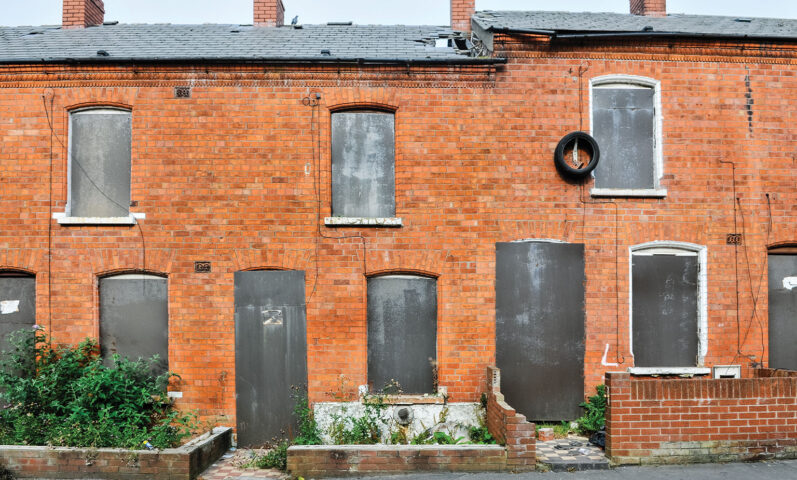
Part of the Government’s aim to increase supply is to be achieved by “working towards ending dereliction and vacancy”.
Arguably the most radical aspect of the Government’s latest housing strategy, Delivering Homes, Building Communities 2025-2030, is the fact that it identifies existing vacant and derelict properties as an important source of additional housing supply.
Alongside new housing delivery, the plan sets out a range of measures intended to return more existing properties to productive use through financial incentives, stronger enforcement, planning reform, and urban regeneration initiatives.
While the delivery of new homes remains the primary objective of the Government’s housing strategy, the plan recognises that increasing supply also requires making better use of Ireland’s existing housing stock.
Vacant homes, derelict buildings, underutilised commercial properties, and upper floors above retail premises are all identified as opportunities to increase housing supply while supporting the regeneration of towns, villages, and city centres.
The strategy therefore seeks to complement new construction by reducing the number of buildings lying idle and bringing more properties back into residential use.
The Government argues that this approach can help deliver housing more quickly than new developments in many cases while also making more efficient use of existing infrastructure, services, and established communities.
Vacancy and dereliction
Despite some progress in recent years, the Government acknowledges that significant numbers of vacant and derelict properties remain across the country and that further intervention will be required if these buildings are to make a meaningful contribution to overall housing supply.
The action plan therefore combines financial incentives with stronger regulatory and enforcement measures designed to encourage owners either to renovate properties or return them to productive use. Local authorities are expected to play a central role in delivering this objective through a coordinated approach involving planning, regeneration, housing, and vacant homes teams.
Building on the Vacant Property Refurbishment Grant, the Government intends to expand supports available to property owners over the lifetime of the plan. A target has been established to bring 20,000 vacant homes back into residential use through the refurbishment grant scheme.
Recognising the challenges associated with converting older commercial buildings, the Government also proposes introducing an ‘above the shop’ top-up grant to support the conversion of vacant upper floors into residential accommodation.
In addition, an expert advice grant is to be introduced to assist owners in assessing complex refurbishment projects before significant investment decisions are made.
The action plan also proposes extending and expanding the Living City Initiative. Originally introduced to support regeneration in designated historic urban areas, the initiative will be broadened to include residential properties constructed before 1975 and additional urban centres identified within the National Planning Framework.
The objective is to encourage investment in older buildings while supporting town centre regeneration and increasing residential density within existing communities.
Stronger enforcement
Alongside grant schemes, the Government intends to strengthen enforcement measures where properties remain vacant or derelict.
The plan places renewed emphasis on the use of compulsory purchase powers by local authorities to acquire long-term vacant and derelict properties where engagement with owners has not resulted in action.
The existing Compulsory Purchase Order Activation Programme is to be expanded to support local authorities in acquiring more vacant sites and buildings for housing purposes.
To improve transparency, annual performance data relating to compulsory purchase activity and the management of vacant and derelict properties will be published.
The Government also intends to replace the existing Derelict Sites Levy with a new self-assessed derelict property tax. This is due to be implemented on a phased basis throughout the State, beginning in 2027.
Under the proposed arrangements, local authorities will continue identifying qualifying properties and maintaining local registers, while Revenue will assume responsibility for administering and collecting the tax.
The aim of this approach is to strengthen compliance while ensuring that derelict properties are subject to a more effective taxation regime.
Planning and regeneration
The strategy also identifies planning reform as an important mechanism for increasing housing supply from existing buildings.
The Government proposes expanding categories of exempted development to facilitate measures such as attic conversions, subdivision of existing homes, and the construction of detached accommodation within residential curtilages.
These reforms are intended to remove planning barriers to increasing housing density within existing neighbourhoods.
The action plan says that the Urban Regeneration and Development Fund will also continue supporting the acquisition and redevelopment of vacant and underused sites capable of delivering housing.
The revolving acquisition programme is expected to play an important role in unlocking difficult sites that have constrained wider regeneration projects in towns and cities.
Taken together, these measures seek to integrate housing delivery with broader objectives relating to economic regeneration, heritage conservation, and town centre renewal.
Local authority delivery
The action plan places significant responsibility on local authorities to coordinate efforts to reduce vacancy and dereliction. Dedicated vacant homes officers are expected to continue working alongside housing, planning, and regeneration teams to identify suitable properties, engage with owners, and coordinate intervention where necessary.
The Government also proposes developing a national digital Derelict Sites Register to improve transparency and provide a consistent approach to monitoring progress across local authorities. The overall goal of this is to create a more coordinated national approach to returning vacant properties to residential use.
Analysis
The emphasis placed on vacancy and dereliction within Delivering Homes, Building Communities represents a notable development in government housing policy.
Rather than focusing exclusively on new construction, the plan formally recognises existing vacant and derelict buildings as an additional source of housing supply and proposes a broader range of interventions than previous strategies.
The combination of grants, taxation, planning reform, compulsory purchase powers, and regeneration funding reflects a more comprehensive approach than relying solely on financial incentives.
However, many of the measures outlined, including compulsory purchase, owner engagement, and enforcement of the proposed derelict property tax, will require significant administrative capacity and consistent application across the country.
Questions also remain regarding the scale of additional housing that can realistically be delivered through refurbishment alone. While the target of bringing 20,000 vacant homes back into use is significant, it represents only a relatively small proportion of the Government’s overall ambition to deliver 300,000 homes over the lifetime of the plan to 2030.