
Progress in Irish housing policy
11th September 2026
How The Housing Agency supports learning in the housing sector
11th September 2026Ending the ‘Eircode lottery’
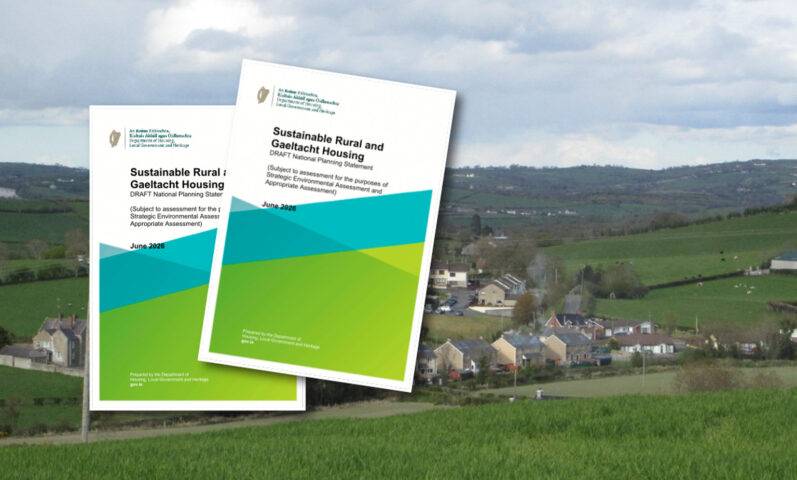
Ahead of the publication of the final National Planning Policy Statement at the end of 2026, the Government has announced its support for a nationwide planning framework which would move away from the authority-by-authority approach to rural and Gaeltacht housing policy.
The proposal, published in June 2026, would establish a more nationally standardised framework for rural housing, while applying differentiated planning criteria according to the characteristics and development pressures of individual rural areas.
Under the proposed policy, rural settlements with fewer than 1,500 people would no longer be subject to ‘local needs’ criteria. Applicants could therefore seek planning permission for a dwelling in such settlements without demonstrating a defined period of local residency or family and social connections to the area. Proposals would remain subject to standard planning, siting, design, environmental, and infrastructure requirements.
The principal restriction would instead apply to open countryside surrounding cities, larger towns, and commuter areas. These locations would be formally designated as ‘rural areas under urban influence’. Within these areas, applicants would generally be required to demonstrate a genuine local economic or social need. The standard social-need criterion would comprise having lived or worked within up to 10km of the proposed site for at least seven years, with potentially more stringent 3km/10-year requirements applying in areas experiencing particularly high development pressure.
Conversely, in wider rural areas outside areas of significant urban influence, the framework would adopt a considerably more permissive approach. Applicants would generally be able to seek planning permission for a dwelling without demonstrating a local connection, subject to the applicable planning, environmental, siting, and design criteria.
A significant change would also apply within Gaeltacht areas. New single rural dwellings would remain subject to local-needs criteria, while applicants demonstrating B2-level spoken Irish could benefit from greater flexibility in satisfying the social needs test.
Minister for Housing, Local Government James Browne TD says: “This new statement, when finalised, will replace the current guidelines with a clearer, more consistent national approach to the delivery and assessment of new housing in rural and Gaeltacht areas, ensuring that planning decisions are transparent, evidence-based, and applied consistently across all local authorities, and will meet the local housing needs of rural communities.”
Gaeltacht Minister Dara Calleary TD says: “The draft policy strengthens the planning system’s support for the Irish language in Gaeltacht areas, making it clearer and more consistent by setting out the language criteria, which may be submitted with applications for new single rural dwellings and requiring a proportion of multi-unit developments to be lived in by Irish speakers.”