
Unlocking construction with skills and MMC
11th September 2026
Ending the ‘Eircode lottery’
11th September 2026Progress in Irish housing policy

Irish housing policy has moved meaningfully over the past two years, writes Donald MacDonald, Director at Hooke and MacDonald.
The shift from the previous government’s strategy Housing for All to Delivering Homes, Building Communities 2025-2030, combined with new compact housing and revised apartment guidelines, fiscal supports, and the establishment of the Housing Activation Office, represents substantive change rather than cosmetic re-branding.
At national level, this is now widely viewed as a coherent framework. The OECD has described Ireland’s housing strategy as comprehensive in scope, while stressing that implementation speed will determine outcomes. Policy direction is no longer the primary constraint; execution is.
However, that same analysis flags growing delivery stress at local and project level. Zoning remains uneven across local authorities. Serviced land is scarce in precisely the regions with the strongest demographic growth. Planning timelines, while improving, remain vulnerable to delay through appeals and judicial reviews. These frictions disproportionately affect apartments and urban schemes, where scale and complexity amplify risk.
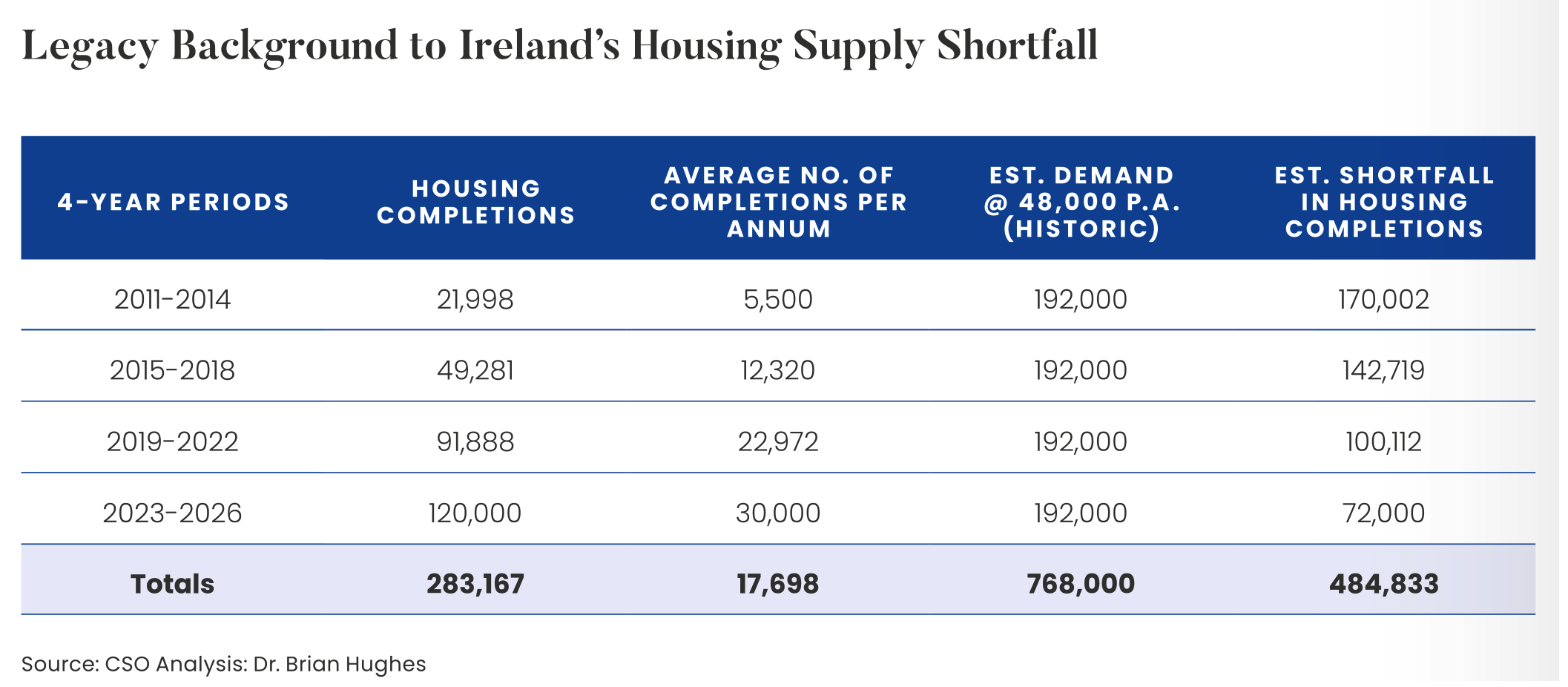
Demographic data from the CSO points to continued strong population growth, increased household formation and persistent structural undersupply, particularly in the Greater Dublin Area/Mid East and other urban areas.
First time buyers remain central, supported by Help to Buy and First Home Schemes, although the €500,000 upper threshold on the Help-to-Buy scheme is out of date having been set eight years ago. Demand for energy efficient homes continues to grow, reflecting both running cost awareness and lender incentives.
Attention has turned to downsizing and right sizing. The Central Bank’s April 2026 decision to exempt certain principal residence bridging loans from loan to income limits reflects a recognition of a long standing market inefficiency: asset rich, income poor households, often older owner occupiers, were effectively blocked from moving. This targeted adjustment is explicitly designed to improve market liquidity without weakening lending standards.
The impact of the changes in the cost landscape as a result of the war in the Middle East is still yet to be determined, but it is already impacting construction costs and new supply, bringing added risk to projects and impacting viability.
Demand for new homes in Ireland is at an all-time high, particularly from first-time buyers, largely as a result of the bulging demographics and an Irish economy with many strong fundamentals, including Exchequer surpluses. Supply is increasing steadily but not yet at a pace that will match government targets or homebuyer needs.
The building industry has been playing its part by acquiring multiple sites, where available, seeking planning permission in a difficult environment, developing larger sites at speed, producing superb quality, well designed, energy efficient new home developments and creating vibrant new communities around the country. All this, despite a considerable number of obstacles in the way of new homes delivery.
Obstacles to delivery
The obstacles to delivery include the following:
- insufficient zoned land for housing at affordable prices and a lack of urgency by some councils in finalising development plans and zoning sufficient land to match the latest population increases. At central and local levels, Ireland has been underproviding in terms of zoned land;
- planning decision delays and uncertainty, planning appeals, and judicial reviews;
- infrastructural deficits with lack of electricity, water, and other services;
- recent legislative changes allowing development plans to be extended by two years, while necessary, add another layer of complexity and risk;
- design changes to make apartment delivery more viable being held up by court proceedings;
- the regulatory costs that are mounting up, pushing up house prices and reducing delivery viability. These include the concrete levy, carbon tax, Part V increased to 20 per cent and the water levy;
- shortage of availability of equity capital to assist small-and medium-size developers to acquire land and fund early project stages;
- cost and availability of debt finance for the acquisition of zoned and un-zoned land;
- increased cost of building materials caused by the conflict in the Middle East; and
- the prospect of rising inflation and interest rates.
Several positives
On the positive side, there are several factors that are assisting homebuyers, particularly government and state initiatives:
- the Help to Buy Scheme, the First Home Scheme, the Affordable Purchase Scheme, and the Croí Cónaithe (Cities) Scheme;
- the formation of the ‘Accelerating Infrastructure Taskforce’ by the Government and the commitment to abide by its recommendations is hugely significant and helpful;
- the establishment of a Joint Utilities and Transport Clearing House to improve co-ordination between local authorities, utilities, and transport bodies;
- the impressive performance by the Land Development Agency (LDA) in delivering an ever increasing supply and a range of tenures is very positive in solving the shortage of new homes. The healthy collaboration between the LDA and the private sector is working well and to the benefit of homebuyers and renters; and
- the announcement by the Central Bank in April 2026 that it was dropping loan to income restrictions on certain ‘bridging loans’ for principal private residential properties, which will assist many people in downsizing to an alternative property.
New homes continue to be more popular with purchasers than existing properties, their energy efficiency being a big factor in this. This trend is likely to increase further if energy cost increases continue to be caused by the war in the Middle East.

Hooke & MacDonald,
118 Lower Baggot Street,
Dublin 2
T: 01 661 0100
Donald MacDonald
Director
E: donaldm@hmd.ie
W: www.hmd.ie